Much has been discussed on the prevailing role of state intervention all around the world. The discussions of state intervention have frequently been associated as an exemplary cause of poor countries. Though the list is not exhaustive, there remains a minority in which the extremeness of state intervention in the country has been the sole factor of developing the country from a third-world to a first-world. The country is none other than Singapore.
Ever since its independence in 1965, the government played a pivotal role in driving much of its structural transformation over the past 50 years. In this article we would examine the role played by the government that would eventually revolutionise Singapore’s living condition as well as the economy.
“I am often accused of interfering in the private lives of citizens. Yes, if I did not, had I not done that, we wouldn’t be here today. And I say without the slightest remorse, that we wouldn’t be here, we would not have made economic progress, if we had not intervened on very personal matters – who your neighbour is, how you live, the noise you make, how you spit, or what language you use. We decide what is right. Never mind what the people think.” Lee Kuan Yew – The Straits Times, 20 April 1987
First is the belief that the government should participate in the economy actively and that such intervention in the market are limited to only improving the efficiency of the market, leaving the fate of the economy to free market forces. The success of government intervention in the early years of independence reinforced this belief which has since become part of the government’s DNA. Right from the start, the government has not hesitated to heavily invest in strategic industries that are deemed critical to the development of the economy. The extensive use of Government-linked Companies (GLC) such as DBS Bank, Singtel and Singapore Airlines have been used extensively to carry out business and economic activities that made significant impact on the private sector. The government’s pragmatism is embodied in its willingness to continually calibrate the balance between state intervention and the preservation of market forces at work.
Secondly, when Singapore was abruptly forced out of the Federation of Malaysia in 1965 while being subjected concurrently to conflict with Indonesia, it was a stagnant entrepot economy and a crumbling city with a large slum area and an unemployment rate of over 10%. Having to curb unemployment and drive growth, Foreign Direct Investment (FDI) had to be attracted in order to provide more jobs for the economy. The government’s response to this was to open its economy, not only in goods and services bit also in the movement of capital and labor. In a sense, the global economy is its “Hinterland”. The government’s intervention to attracting FDI proved successful. Many MNCs from US, Europe and Japan relocated to Singapore due to rising costs at home or the need to penetrate into new markets. Of course, with large capital inflows there has to be a political framework in ensuring a certain level of social stability. National Trade Union Congress (NTUC) and National Wages Council (NWC) were formed to preserve industrial peace important to foreign investors.
Third, to maintain stability in the economy, the government had to ensure a zero tolerance for corruption. A carrot and stick approach was taken to minimize corruption in the public service. In the 1970s, senior policymakers including ministers were charged in court for corrupt practices. At the same time, the wages of civil servants were on par or higher than that of the private sector to help the government recruit and retain the best people in the country.
Lastly, the erection of the Housing and Development Board (HDB) began operations on 1st February 1960 as a replacement of the Singapore Improvement Trust (SIT) to provide decent homes equipped with modern amenities for those who needed them. The result was the increase of homeowner ship rate for the resident population from 29% in 1970 to 88% in 1990.
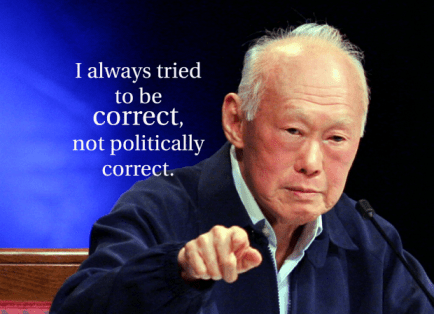
“ My primary preoccupation was to give every citizen a stake in the country and its future. I wanted a home-owning society. I had seen the contrast between the blocks of low-cost rental flats, badly misused and poorly maintained, and those of house-proud owners, and was convinced that if every family owned its home, the country would be more stable… I had seen how voters in capital cities always tended to vote against the government of the day and was determined that our householders should become homeowners, otherwise we would not have the political stability. My other important motive was to give all parents whose sons would have to do National Service a stake in the Singapore their sons had to defend. If the soldier’s family did not own their home, he would soon conclude he would be fighting to protect the properties of the wealthy. I believe this sense of ownership was vital for our new society which had no deep roots in a common historical experience.” – Lee Kuan Yew 2000
Certainly, there were many more significant interventions the Singapore government did such as the Central Provident Fund (CPF) scheme which partly helped to finance the citizens’ house and the establishment of the NEWater to ensure sufficient water supply to Singapore and reduce the reliance of water supply from Malaysia of which is binded to a contract that expires in 2061. But to explicitly state each and every one will be tedious task to such a brief and short article that I attempt to confer.
While the government intervention has achieved a huge economic success till 1990, it was not all rainbows and sunshine. The government’s obsessed-GDP approach to restructuring the economy has created problems for the country. Not exhaustive, increased income inequality and high influx of foreign talent had caused Singaporeans to voice out discontent in such matters. Nevertheless, the leadership role Lee Kuan Yew undertook in his time as prime minister (1959 – 1990) greatly contributed to the success of Singapore.


 baatbaakman.blog