Just last week, the Strait Times Index hit its highest since pre 2007-2008 financial crisis of 3,525 points, breaking the 3,500 barrier. While investors are happily profiting from this surge in index, it was inevitable to consider whether this may lead to a bull run caused by speculation in the market. The last thing all investors would want to see is history repeating itself; STI crashing to FEB 2009 low of 1,594 points. With that in mind, I attempt to compare the similarities in situations during the pre 2007-2008 financial crisis and what is going on now.
The Singapore Interbank Offered Rate (SIBOR) for 3 months as of 16 April 2015 stands at 0.94654 points while the pre 2007-2008 level was harbouring around 3 points as can be seen in the chart below.
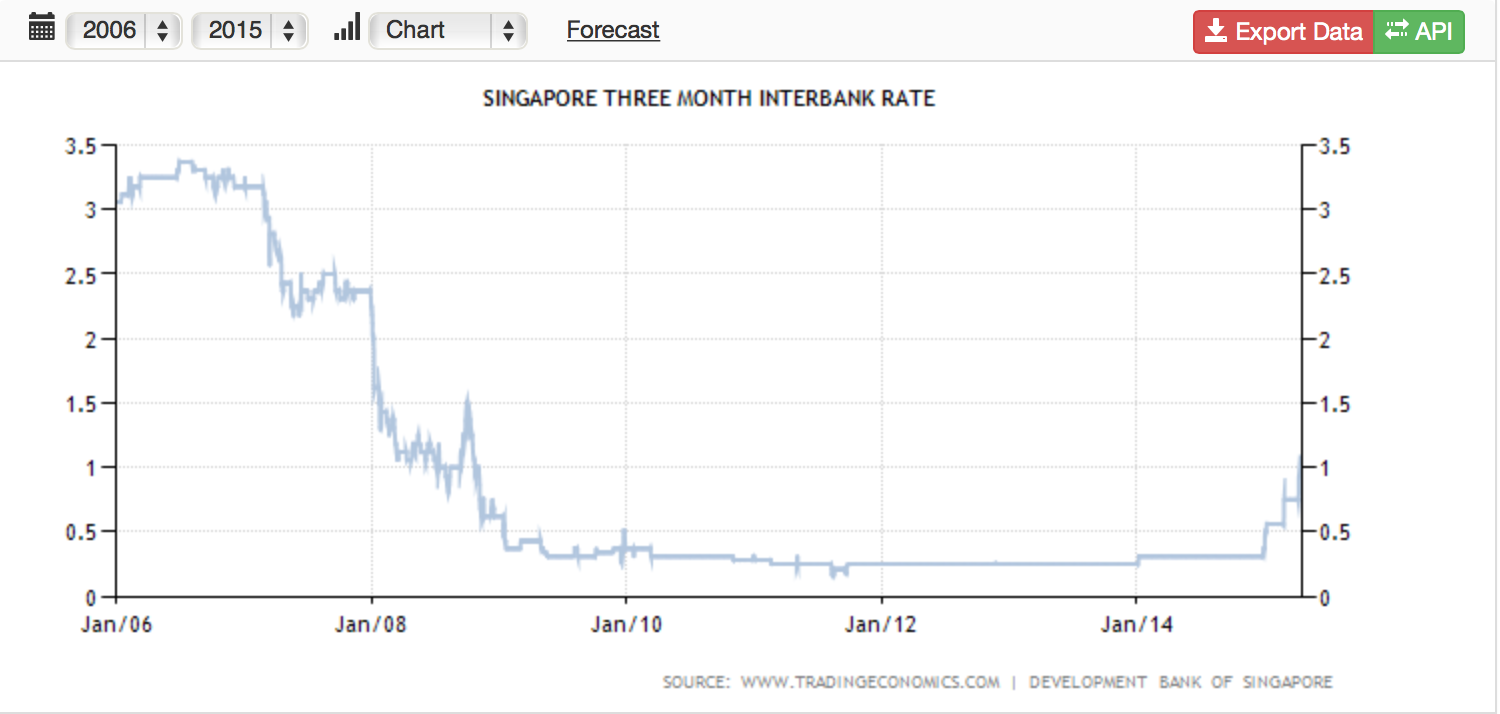
Since the Monetary Authority of Singapore (MAS) doesn’t conduct as big open market operations as the US Feds, the data above provided evidence that businesses and consumers were not over borrowing as compared to the pre 2007-2008 financial crisis. As such it was unlikely that over speculation exists in the Singapore market. Even though there showed no signs of speculation, it could be that the market is currently over valued. In the chart below, it provides data on the loan growth in Singapore. As at the end of 2014, loan growth to businesses fell from 9.2% to 6.4% previously while loans to the manufacturing sector plunged by 6.3%. Loans to the petroleum-related industry also moderated sharply to 27.3%, from 63.3% in November could be mainly due to the plunge in oil prices. Such data indicates a slowdown in business activity.
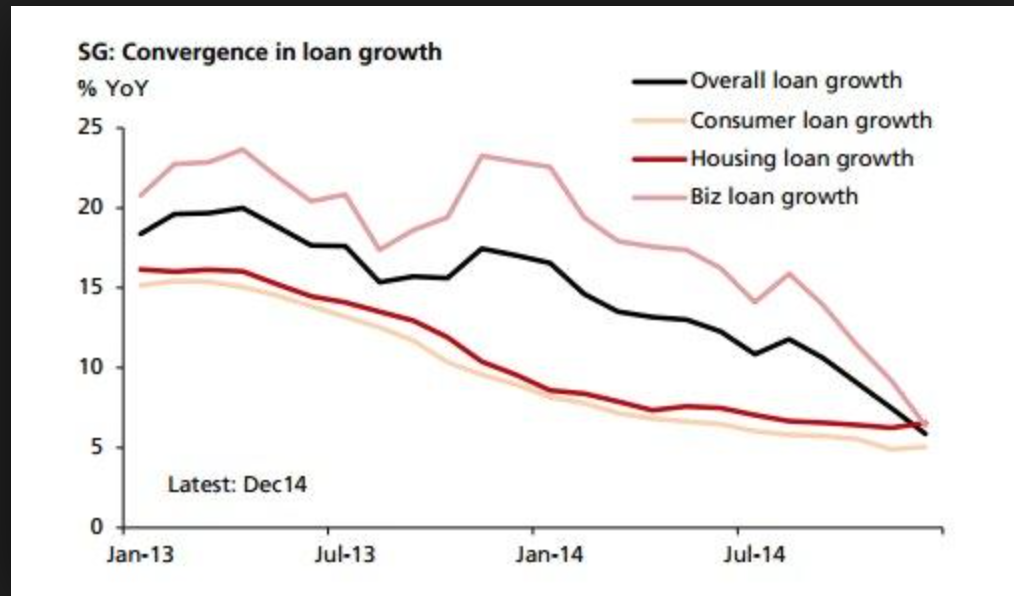
On the other hand, inflation edged slightly to -0.3% as of February, up from -0.4% in January. The drop in inflation was caused mainly by accommodation and transport cost. The core inflation for the respective month was 1.3% higher than the previous year. As compared to the pre 2007-2008 financial crisis, the inflation rate then was about 4-8%. The comparison between both sets of data shows that Singapore was experiencing a slowdown in growth in the economy. Another factor that might be going to propel the slowdown was the decision by the MAS a week ago to maintain a modest and gradual appreciation of the Singapore dollar which could hurt exports as a stronger currency will decrease foreign purchase of domestic assets.
Ever since being affected by the 2007-2008 financial crisis, Singapore has implemented policies which aimed to curb speculation in the market. One example is the cooling measure of property purchases through the induction of the TDSR framework. Since then property prices has been moderating. Looking through the charts, it would seem like the Singapore market is currently experiencing an unsustainable temporary boom which could be corrected in the near future. As central banks around the world becomes more involved in open market operations, the uncertainty globally has increased. Thus, the ups and downs of the stock market could be affected base on the decisions of different central banks around the world regarding their monetary policies. In conclusion, I reckoned the Singapore market comprised not of speculation but of overvalued companies caused by the very uncertain global environment created by central banks around the world.


 baatbaakman.blog