If you’d read the news frequently, economist often use key words such as “Bond yields” and “interest rates” as an economic indicator. At first glance, it could be hard to comprehend why these indicators are used to gauge the performance of the economy. In this article I will endeavor to explain the intricacies of such subject matter to help better understand the functions of these indicators.
A bond is a financial instrument in which the investor loans money to an entity for a defined period of time at a fixed interest rate, known as the coupon rate. These bonds are commonly used by companies, foreign governments and states to finance a variety of projects and activities. In the United States, there are 3 different types of treasuries mainly the Treasury bill, Treasury Notes and Treasury Bonds. They all differ according to the maturity period respectively with Treasury Bonds being the one with the longest maturity period. It is not unusual to see the longer the maturity period, the higher the yield (as shown below).
US TREASURY YIELDS

The interest rate is somewhat similar to the coupon rate of the treasuries with the only difference lies in the flow of money. The interest rate is usually charged to the lender while the bond yield issues money to the lender. The interest rate is a good indicator to follow as it signals the direction in which the economy is intended to head. For example, when the Federal Reserve began its Quantitative Easing, it’s a sign to stimulate the economy.
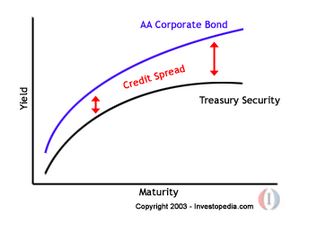
In many cases, investors use the treasury yield as the benchmark for corporate bonds such as that of banks. The difference in the yield is known as the credit spread.
When inflation are increasing, the credit spread widens due to the higher risk associated with corporate bonds thus investors will be offered additional compensation. Vice versa, when interest rates are declining, the credit spread narrows, giving companies the opportunity to borrow at very low rates which allows them to expand their business. Generally, when market rates (Treasury yield) rise above the interest rate earned the value of the corporate bond decrease. Conversely, when market rates falls below the interest rate earned, the value of the corporate bond increases.
Why then, do economists frequently use the Interest rate and Treasury yields to gauge the performance of the economy? When the economy grows, businesses increase the quantity of goods and services they provide. As a result, it increases the demand for workers who are also consumers of other businesses. This creates a Keynesian Multiplier which trickles down the economy. Higher interest rate which signals economic growth will cause the bond prices to fall hence, many professional bond investors fear inflation.
Likewise, in a falling interest rate environment, it could mean firstly, that consumers and businesses are not borrowing money and if money demand declines, so does the interest rates and its price. Secondly, it could signal that a recession is coming and thus, the Federal Reserve eases the interest rate to stimulate growth such as the massive QE program launched by the European Central Bank.
Given a long time frame, Treasury yields are correlated with economic conditions. In summary, treasury yields can in some ways act as an economic indicator, signaling which direction the economy is heading towards to. While a low yield might boost home purchases, investors should be cautioned of the sub-prime mortgage crisis which happened during the period of 2007 to 2009.


 baatbaakman.blog