Roughly 3 months after the 2008 housing market crash, Chairman of the Federal Reserve then, Ben Bernanke, unveiled a stimulus programme also known as the Quantitative Easing (QE) to help stimulate the economy. According to Bernanke, the objective was to keep interest rate low so that home prices would go up. And the increase in home prices would produce a wealth effect that is, causing home owners to feel wealthy and thus spending more money. This illusion of wealth is deadly as it encourages people to buy stuff that they can’t afford not because they earned the money, but because their houses are appraising at a higher value! Let’s not forget that the 2008 housing market crash was in part contributed by the supply of cheap credit.
Since QE creates what Austrian Economists call the “Boom and Bust Cycle”, why then does the U.S government continues to support it? As a matter of fact, QE is the only way to finance higher government spending without taxing or borrowing from the public.
In the name of creating low unemployment rate, unproductive jobs are created. Take for example, government builds a road, paying for the expenses incurred with newly printed notes. It looks as if everyone is better off. The workers get paid for doing their job and now there is a road newly erected. Who paid for it?
The answer is that everyone holding the money paid for it.
The expansion of money supply created inflation when it was used to employ the workers to build the road instead of engaging in some other productive activity. The inflation is then maintained as the extra money supply circulates in the spending stream from the workers to the sellers, and from the sellers to others and so on. Hence, the higher prices meant that the money people previously had will now buy less than it would have before, creating a phony inflation that doesn’t reflect the real growth of the economy.
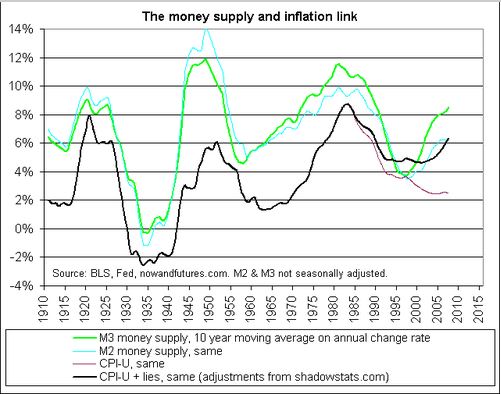
In conclusion, the inflation that the Feds is creating under the false pretense of an improved economy doesn’t help the public because thanks to inflation, our savings are losing value. And not to mention, the dollars that the U.S government pays back can buy less than the dollars it borrowed from us! It is about time we start to reflect on the relevancy of the Keynesian model and start to think for our future generations instead of passing on the debt to them.
After all, slow growth is always more stable than fast growth and when you have fast growth which reflects a higher inflation, it create corrections which causes recessions/depressions.
To end off, I quote Milton Friedman:
“Government has three primary functions. It should provide for military defense of the nation. It should enforce contracts between individuals. It should protect citizens from crimes against themselves or their property. When government – in pursuit of good intentions tries to rearrange the economy, legislate morality, or help special interests, the cost come in inefficiency, lack of motivation, and loss of freedom. Government should be a referee, not an active player.” – Milton Friedman


 baatbaakman.blog